
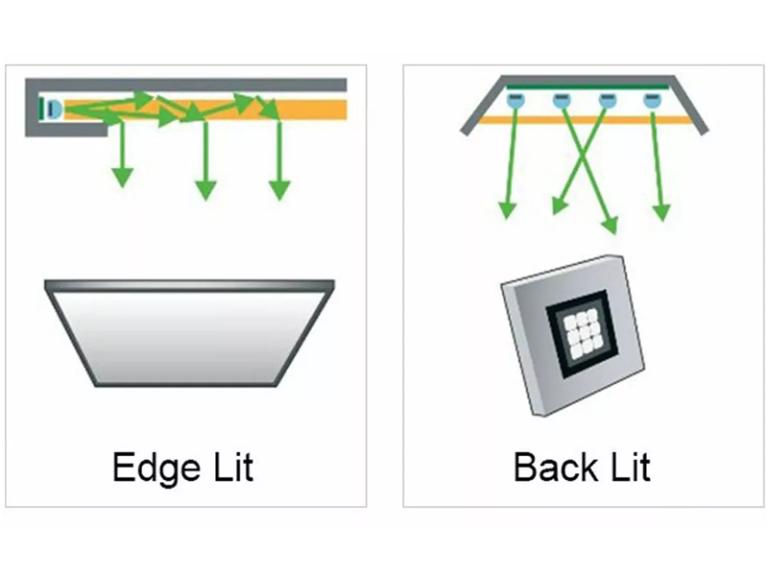
In the world of modern lighting, LED panels are mainly divided into two types: Backlit and Edgelit. Backlit lights are designed with the light source positioned behind the panel, allowing light to be emitted directly and evenly across the entire surface. This feature ensures shadow free illumination and a consistent, uniform brightness.
For this reason, these lights are highly popular in workplaces, retail stores, kitchens, and areas that require precise and uniform lighting. In contrast, Edgelit lights use LEDs along the edges of the panel, and light is distributed across the surface through a light guide plate.
This design makes the panels thin and lightweight, giving them a modern and elegant appearance. Edgelit panels are commonly used in residential spaces, living rooms, and areas where aesthetics and subtle design are important. Both types of lights have their advantages and limitations, and the choice between them depends on the application, budget, and lighting requirements of the space.
Definition and Differences Between Backlit and Edgelit Lights
In the LED lighting industry, choosing between Backlit and Edgelit lights can significantly affect light quality and energy consumption. As mentioned earlier, Backlit lights have the light source placed behind the panel, allowing light to shine directly from the entire surface.
This design ensures even and uniform illumination without any dark spots or shadows. Therefore, these lights are ideal for spaces that require strong and consistent lighting, such as offices, kitchens, and retail stores.
On the other hand, Edgelit lights use LEDs along the edges, with light distributed across the surface via a light guide plate. This design makes the panels thinner and lighter while providing a more elegant appearance, though in some cases, light uniformity may be slightly lower than that of Backlit panels.
Edgelit lights are very suitable for residential spaces, living rooms, and environments where subtle design is important. One key factor in choosing between these two types is energy consumption and LED lifespan.
Typically, Edgelit panels consume less energy due to fewer LEDs and a thinner design, but in larger panels, light may be somewhat diffused and less uniform. Backlit panels, on the other hand, provide more uniform light and higher quality, though they generally have higher initial costs and energy consumption.
Ultimately, the final decision depends on the application, budget, and how important light quality is for the space. Comparing Backlit and Edgelit lights helps you understand the advantages and disadvantages of each type of LED panel and make the best choice for your environment.
Advantages of Backlit LED Panels
Backlit lights are among the most popular types of LED panels due to their highquality and uniform light, making them suitable for many commercial and residential environments. The main feature of these lights is that the light source is positioned behind the panel, emitting light directly from its surface.
This design ensures consistent light distribution without dark spots or distracting shadows, making it ideal for work and study areas. Another advantage of Backlit lights is their high color quality and clarity.
These lights typically have a higher color rendering index, showing colors more naturally and vividly. Therefore, they are an ideal choice for spaces that require accurate and natural light, such as galleries, retail stores, and offices.
Backlit lights are also very reliable in terms of durability and lifespan. Their internal design allows heat to disperse evenly, reducing stress on the LEDs and increasing the panel’s longevity.
Additionally, these panels are suitable for large spaces and widearea lighting because they produce uniform light that can effectively illuminate the entire area. Economically, Backlit lights may be slightly more expensive than Edgelit panels, but their light quality and ease of use make them a worthwhile investment.
They also require less maintenance and provide consistent, reliable performance over time. Overall, comparing Backlit and Edgelit lights shows that Backlit panels are ideal for those seeking uniform lighting, high quality, and longlasting durability.
Advantages and Applications of Edgelit LED Panels
Edgelit lights generate light from the edges of the LED panel, which is then distributed across the surface through a light guide plate. This design makes the panels extremely thin and lightweight, with a sleek and modern appearance.
One of the greatest advantages of this type of light is its suitability for spaces where decorative design and aesthetic appeal are important, such as living rooms, hotels, and exhibition halls. Edgelit lights typically consume less energy because they use fewer LEDs than Backlit panels, with light distributed via the guide plate.
This makes them an excellent choice for spaces that require effective lighting with lower energy consumption. Additionally, their lightweight and slim profile make installation easier and increase design flexibility, especially in false ceilings or illuminated walls.
Edgelit lights also provide soft and pleasant illumination due to the light spreading from the edges, making them ideal for spaces that do not require direct or intense light. These panels can add a luxurious and modern touch to a room, and with various LED colors, they can create a warm and inviting atmosphere.
Therefore, comparing Backlit and Edgelit lights shows that Edgelit panels are an optimal choice for spaces where aesthetics, lower energy use, and gentle lighting are important.
Energy Consumption in Backlit and Edgelit Lights
One of the most important factors in choosing an LED panel is energy consumption, as it directly affects electricity costs and overall efficiency. Backlit lights typically consume more energy than Edgelit panels because they use multiple LEDs and emit light directly across the entire surface.
These lights are suitable for spaces that require strong and uniform illumination, but their higher power consumption can increase long term costs. In contrast, Edgelit lights use fewer LEDs positioned along the edges of the panel and distribute light through a light guide plate, resulting in lower energy usage.
This feature makes Edgelit panels more suitable for environments with moderate lighting needs or where a slim and lightweight design is preferred. Additionally, lower energy consumption generates less heat and reduces stress on the LEDs, which can extend the lifespan of the panel.
The choice between these two types should be based on the required brightness level, the size of the space, and the electricity budget. Backlit panels are ideal for offices, retail stores, and kitchens, while Edgelit panels are more commonly used in living rooms, hotels, and spaces with modern and lightweight designs.
Using lighting control technologies such as dimmers or smart systems can also help optimize energy consumption. Overall, comparing Backlit and Edgelit lights shows that Edgelit is more efficient in terms of power usage, while Backlit provides superior light quality and uniformity.
Brightness Intensity and Light Uniformity in Backlit vs Edgelit
Light quality and uniform brightness are key factors when selecting an LED panel. Backlit lights, with their light source positioned behind the panel, are capable of producing wide and highly uniform illumination. They do not create dark spots or shadows, and brightness is distributed evenly throughout the space.
For this reason, they are considered ideal for large areas, offices, retail stores, and kitchens that require direct and consistent lighting. In contrast, Edgelit lights emit light from the edges of the panel and distribute it across the surface using a light guide plate.
This design makes the panels thinner and lighter, but in some situations, the light uniformity may not be as perfect as Backlit panels, and minor variations in brightness may be visible. However, for residential spaces, living rooms, or environments that require soft and diffused lighting, Edgelit panels perform very well.
Brightness intensity is generally stronger and more stable in Backlit panels, making them advantageous for professional environments that require powerful illumination. On the other hand, Edgelit panels create a softer and more pleasant atmosphere, making them suitable for decorative or luxury lighting applications.
In conclusion, comparing Backlit and Edgelit lights shows that Backlit panels have an advantage in brightness and uniformity, while Edgelit panels are better suited for elegant design and softer lighting.
Lifespan and Durability of Backlit and Edgelit Lights
Durability and lifespan are critical factors when choosing between Backlit and Edgelit LED panels. Backlit lights use multiple LEDs and distribute light evenly, which helps disperse heat more effectively and reduces stress on each LED.
This characteristic increases their lifespan and ensures stable and reliable performance over many years. Therefore, Backlit panels are a better choice for environments that require long term and continuous illumination.
Edgelit lights also offer a reasonable lifespan, but since light is concentrated along the edges and fewer LEDs are used, heat may accumulate in specific areas, which can slightly affect durability. However, high quality manufacturing and materials can extend the lifespan of Edgelit panels to an acceptable level, making them a suitable option for residential and lightweight environments.
Usage intensity, ambient temperature, and installation quality also influence the durability of both types. LED panels with proper ventilation and heat dissipation will last longer and maintain consistent lighting performance over time.
Overall, comparing Backlit and Edgelit lights shows that Backlit panels generally offer greater longevity due to better heat distribution and stable internal design, while Edgelit panels can still provide satisfactory performance when properly installed and maintained.
Price of Backlit and Edgelit Panels
One of the most important considerations when selecting an LED panel is the initial cost and long term economic value. Backlit lights usually have a higher upfront price because they use more LEDs and feature a more complex design.
Due to their superior light uniformity and durability, these panels are considered a cost effective long term investment, as they require less maintenance and replacement while delivering consistent and reliable illumination.
Edgelit panels, with their slim design and fewer LEDs, are generally more affordable and suitable for environments with a limited budget. In addition to their lower purchase price, they also consume less energy, which can reduce electricity expenses, especially in residential spaces or areas that do not require intense and perfectly uniform lighting.
However, cost should not be the only deciding factor. Light quality, durability, and application requirements must also be considered. For example, choosing a higher priced Backlit panel may prove more economical over time due to its longer lifespan and consistent light output, reducing the need for frequent replacement. In contrast, Edgelit panels are ideal for those seeking a slim design, soft lighting, and lower initial costs.
Therefore, when making a decision, it is best to compare Backlit and Edgelit panels based on both application needs and budget in order to select the most suitable option in terms of performance and cost efficiency.
Beam Angle and Light Distribution in the Comparison of Backlit and Edgelit Lights
The beam angle is another important feature of LED panels that can significantly affect both illumination and interior design. Backlit lights, due to direct light emission from the entire surface, provide a wide and uniform beam angle that distributes brightness evenly throughout the space. This characteristic makes Backlit panels an ideal choice for large areas and work environments where consistent lighting is essential.
In contrast, Edgelit lights emit light from the edges, resulting in a slightly more limited beam angle. However, the light guide plate design transfers and diffuses the light across the panel surface and into the surrounding area. This makes Edgelit panels suitable for smaller spaces or environments that require softer and more diffused lighting.
Additionally, the slim thickness and sleek appearance of Edgelit panels allow flexible installation in suspended ceilings and illuminated walls. The beam angle also influences the overall atmosphere and decorative effect of a space. Backlit panels create strong and uniform lighting suitable for offices and retail stores, while Edgelit panels provide softer and more diffused light that adds a sense of comfort and luxury.
Ultimately, comparing Backlit and Edgelit lights shows that Backlit panels excel in light uniformity and coverage, whereas Edgelit panels are ideal for designed spaces and residential environments.
Best Applications for Each Type of LED Panel
Selecting the right LED panel depends directly on its intended application and environment. Backlit lights, with their uniform illumination and high brightness intensity, are the best option for spaces that require direct and comprehensive lighting. These panels are highly practical in offices, retail stores, kitchens, and large areas, ensuring that light is distributed evenly throughout the environment.
Furthermore, the high color rendering performance of Backlit panels displays colors naturally and accurately, which is especially important in spaces where color precision matters, such as galleries and art stores.
On the other hand, Edgelit lights, with their slim design and soft illumination, are well suited for residential environments, living rooms, hotels, and spaces where decorative design is important. These panels produce pleasant and diffused light, adding a modern and elegant touch to interiors.
Edgelit panels are ideal for areas that do not require intense and perfectly uniform lighting but prioritize aesthetics and lower energy consumption. They are also easy to install in suspended ceilings and illuminated walls, increasing design flexibility.
Therefore, comparing Backlit and Edgelit panels helps ensure that the most suitable LED panel is selected according to the needs of the space, providing both proper illumination and an attractive visual effect.
Important Considerations Before Buying a Backlit or Edgelit LED Panel
Before purchasing an LED panel, paying attention to several key factors can make your decision more practical and cost effective. First, clearly determine the application and required brightness level. If the space needs strong and uniform lighting, Backlit panels are the best choice. If soft and decorative lighting is more important, Edgelit panels are more suitable.
Energy consumption and budget are also important considerations. Backlit lights typically consume more electricity but provide superior light quality and uniformity. Edgelit panels, with lower energy usage and a slim design, are a good option for reducing electricity costs and installing in narrow ceilings.
Build quality, LED lifespan, and proper heat dissipation should also be evaluated, as panels with effective ventilation offer greater durability and stable light output.
Beam angle and light distribution must not be overlooked. Backlit panels produce wide and uniform illumination, while Edgelit panels create softer and more diffused light. Paying attention to brand reputation and warranty coverage can also help prevent future issues.
In conclusion, reviewing technical specifications and comparing light quality, energy consumption, and lifespan will simplify the purchasing decision. Conducting a thorough comparison of Backlit and Edgelit panels before buying ensures that you choose a panel suited to your space and budget while achieving optimal performance.
Disadvantages and Limitations of Backlit and Edgelit Lights
Although both types of LED panels have their advantages and applications, they also have certain limitations that should be considered before purchase. Backlit lights, due to the higher number of LEDs and more complex design, generally come with a higher price and greater energy consumption.
In addition, their thicker structure and heavier weight may make installation in suspended ceilings or narrow spaces more challenging. In some cases, the intense brightness of Backlit panels may be excessive for residential environments or small rooms and could lead to visual discomfort.
Edgelit lights also have their own limitations. Since light is emitted from the edges, perfect uniformity comparable to Backlit panels may not always be achieved, and slight dim areas or shadows may appear. Lower quality Edgelit panels may also experience reduced LED lifespan and declining light performance over time.
In large environments requiring strong illumination, Edgelit panels may not provide sufficient brightness and could require multiple panels to meet lighting needs.
Despite these limitations, both panel types can deliver effective decorative and functional lighting when properly selected and correctly installed. Evaluating the application, required brightness, and budget beforehand ensures a suitable choice. Ultimately, comparing Backlit and Edgelit panels allows for an informed decision based on both advantages and constraints.
Conclusion
In summary, choosing between Backlit and Edgelit lights depends on the needs, application, and budget of the space. Backlit panels, with their uniform illumination, high brightness intensity, and long lifespan, are an ideal option for workplaces, retail stores, kitchens, and large areas. They provide excellent light quality, strong color rendering, and stable long term performance, though they involve higher costs and energy consumption.
In contrast, Edgelit panels, with their slim design, soft lighting, and lower energy usage, are more suitable for residential spaces, living rooms, hotels, and areas where decorative design is important. They add a modern and lightweight appearance to interiors and are easy to install, although their light uniformity may not fully match that of Backlit panels.
To make the right choice, it is important to consider the application, required brightness level, energy consumption, and budget. Reviewing technical specifications, lifespan, beam angle, and build quality is essential.
Ultimately, conducting a detailed comparison of Backlit and Edgelit panels helps you better understand the advantages, disadvantages, and limitations of each type, enabling a smart decision that provides both effective illumination and an appealing visual result.